


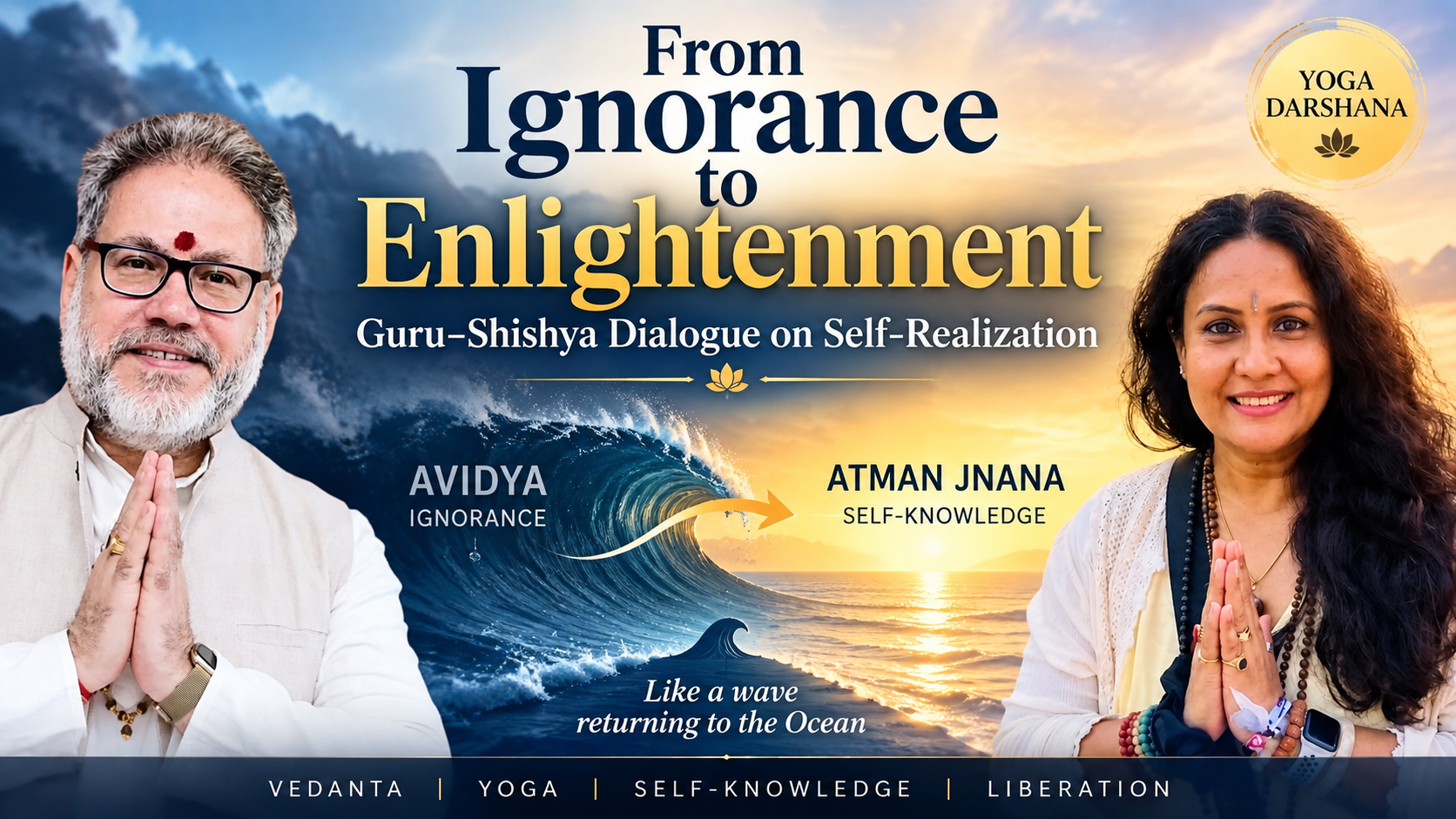
One of the most beautiful ways to understand the spiritual journey is through the metaphor of a wave and the ocean.
Where does the wave begin? It begins with Avidyā—ignorance of our true nature. Where does the wave end? It ends with Ātma-jñāna—the direct realization of the Self. Between these two lies the entire journey of Yoga.
The great sage of the Yoga Vasiṣṭha reminds us that the fundamental human disorder is Ādhi-jā Vyādhi, the primordial disease of repeated birth and suffering. This root disorder does not arise because of the body, the mind, or circumstances. It arises because of Avidyā, the mistaken belief that we are merely this limited body, this restless mind, this changing personality. As long as ignorance persists, we continue to identify with the passing wave instead of recognizing ourselves as the boundless ocean.
What, then, is the antidote?
The antidote is Ātma-jñāna.
Imagine that poison has entered your body. The physician administers an antidote that travels wherever it is needed—through the bloodstream, into the cells, organs, tissues, and every affected part. Once the poison has been neutralized, the antidote has completed its work. You simply return to your natural state of health.
Self-knowledge works in exactly the same way. It is not something that creates your true nature; it merely removes the poison of ignorance that obscures it. When ignorance dissolves, what remains is what has always been present—your own pure consciousness.
Patañjali points us towards this highest realization by explaining that even the most refined aspects of the mind, including the luminous quality of Sattva, must ultimately be transcended. The goal is not simply a calm or peaceful mind, but the direct recognition of Puruṣa, pure consciousness itself.
It is also important to understand that Ātma-jñāna is not merely the final destination. It is a gradual process of transformation.
Today we may begin with information. We read a book, listen to a lecture, or even browse an article online. Information alone, however, is not wisdom. When we find a competent teacher and sincerely reflect upon these teachings, information matures into knowledge. Through disciplined practice, meditation, self-inquiry, and daily living, that knowledge gradually becomes direct experience. Finally, experience flowers into Prajñā—the intuitive wisdom that cannot be borrowed from another but must arise within.
The ancient tradition beautifully describes this progression as Śravaṇa (listening), Manana (reflection), and Nididhyāsana (deep contemplative assimilation). These culminate in the spontaneous dawn of Ātma-jñāna.
Ultimately, the spiritual journey is not about becoming someone new. It is about remembering who we have always been.
The wave never truly becomes the ocean. It simply discovers that it was never separate from the ocean in the first place. When Avidyā dissolves, the illusion of separation disappears, and what remains is limitless awareness, eternal peace, and the joyful recognition of our true Self.
