


Humanity’s greatest quest has always been the search for knowledge—of the world, of life, and of the Self. Science approaches this through observation, experimentation, and proof. Religion, too, was originally born from direct experience—when awakened beings like Buddha, Christ, and the Rishis of India perceived Truth through inner realization. Yet over time, religion became belief-based and divisive, while science became purely material. The meeting point between the two—the art and science of inner experience—is Yoga.
Yoga, in its truest sense, is not a religion but a systematic science of self-knowledge. It begins with one question: “Am I willing to know myself?” Just as physics explores the laws of the external universe, Yoga explores the inner world of thought, emotion, and consciousness. Its laboratory is the human body-mind, and its tools are discipline, observation, and transformation.
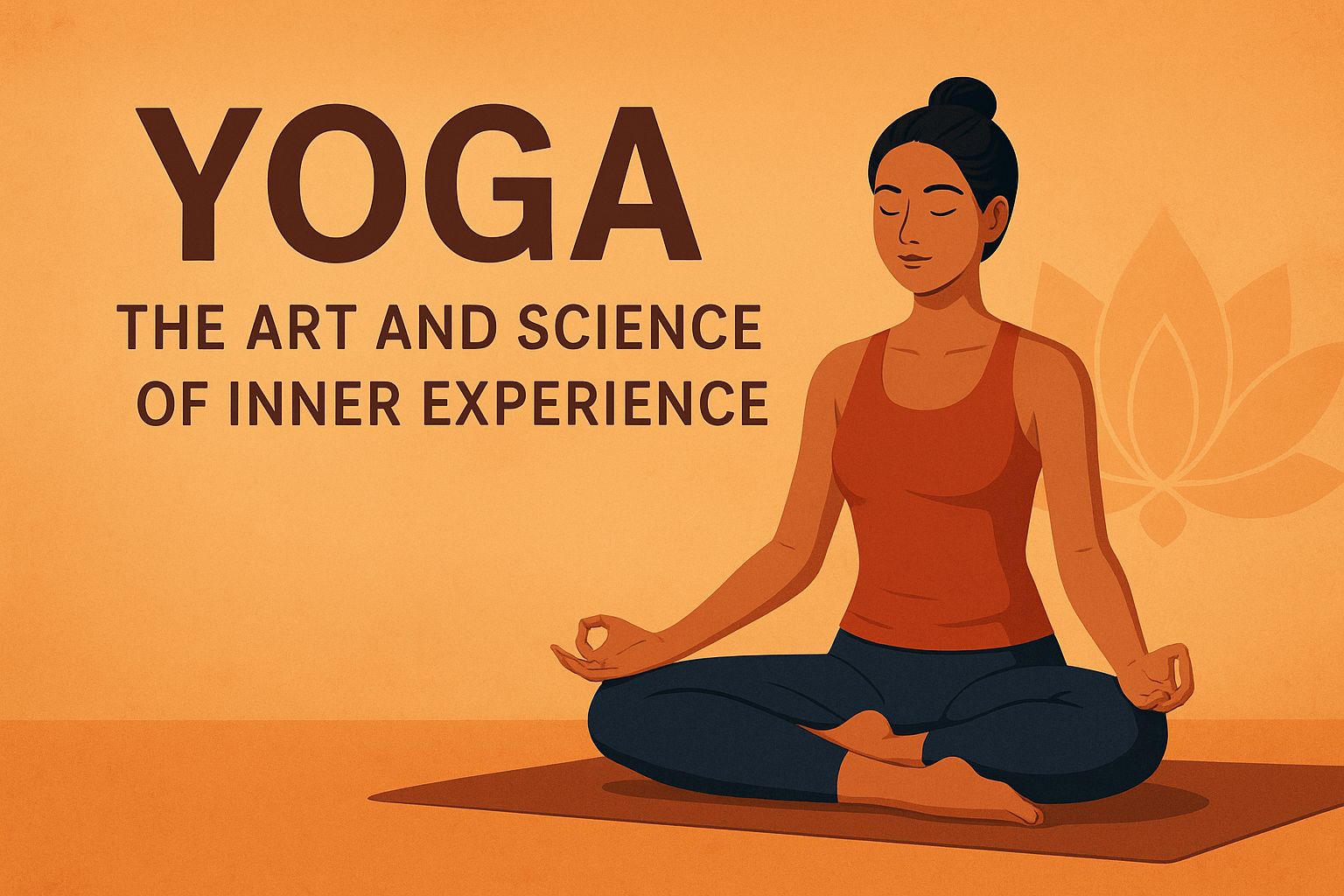
At its heart, Yoga is both an art and a science. The art lies in the sensitive, personal application of practices suited to the individual. The science lies in its universal, verifiable methods that lead to consistent results—peace, clarity, and harmony. Through Asana, Pranayama, and Dhyana, one refines body, energy, and mind, moving from confusion toward self-mastery.
Unlike dogmatic systems that demand belief, Yoga invites experiment. It says: “Don’t believe—experience.” Just as a chemist tests reactions in a lab, the yogi tests inner truths through practice. When practiced sincerely, Yoga becomes the bridge between scientific inquiry and spiritual realization. It transforms philosophy into living wisdom.
The ancient Rishis called this process Adhyatma Vidya—the science of the Self. Modern neuroscience and psychology are now validating what yogic seers understood millennia ago: that conscious breathing calms the nervous system, that meditation restructures the brain, and that compassion, mindfulness, and equanimity enhance wellbeing. The frontiers of modern research are thus converging with the timeless discoveries of Yoga.
research are thus converging with the timeless discoveries of Yoga.
Yoga also restores balance to a fragmented modern life. In a world dominated by stress and digital overload, Yoga offers tools to quiet the restless mind and harmonize the body’s rhythms. It does not deny the material world but helps us live in it with awareness, not attachment. It brings back the art of living consciously—with balance, creativity, and inner joy.
Ultimately, Yoga is the science of union—uniting the finite with the infinite, the individual with the universal. It teaches that the highest knowledge is not external but experiential: to know by becoming. When the seeker turns inward and refines perception through disciplined self-study, awareness blossoms into wisdom. In that state of stillness and clarity, the yogi discovers that consciousness itself is the true field of exploration—and that the universe outside and the Self within are one.
Yoga, then, is humanity’s oldest and most complete experiment in consciousness—a living bridge between science and spirituality, art and awareness, body and soul.
