




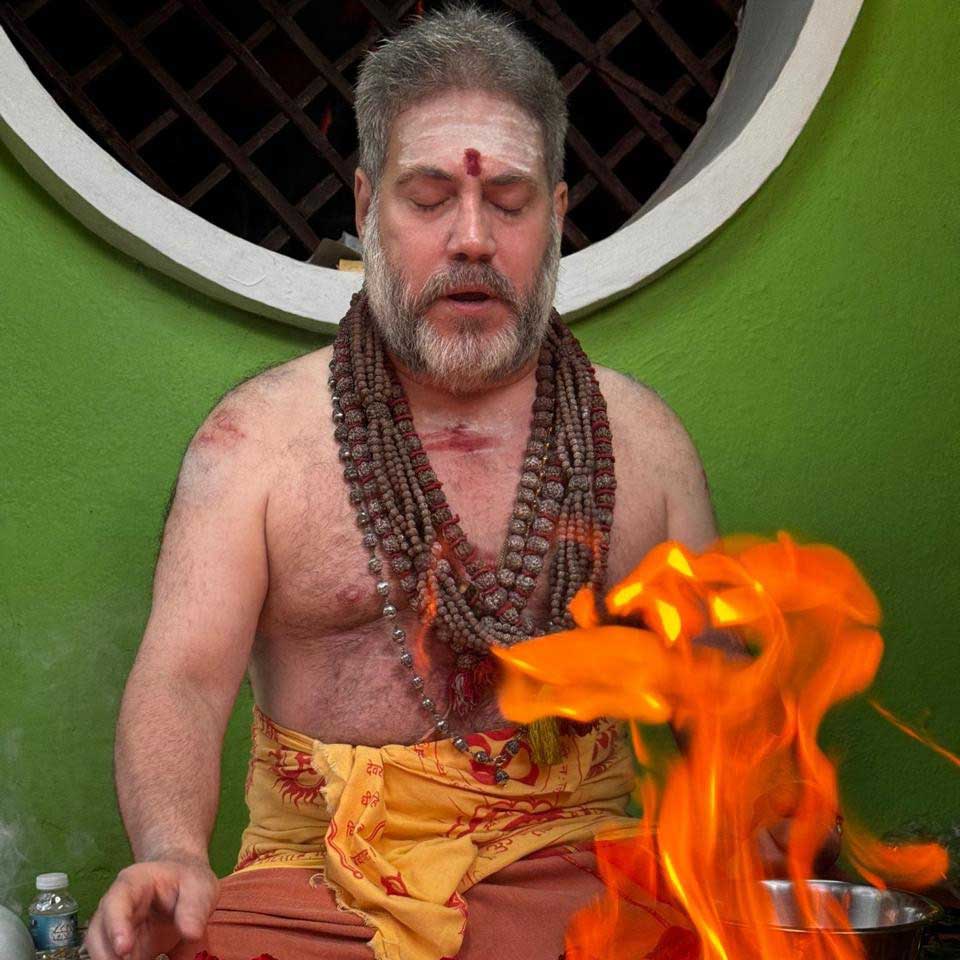
Yogacharya Dr. Ananda Balayogi Bhavanani
I was born into a lineage of Yoga masters and raised in the unique environment of an Ashram, yet my life also led me to train as a modern medical doctor. Living at the intersection of these two worlds—tradition and science—has shaped my entire perspective on Yoga therapy. Over the years, I have come to understand that Yoga therapy is not just a collection of techniques but a profound, transformative process grounded in authentic experience and lived wisdom.
Growing Up in the Ashram
My childhood was anything but ordinary. From my earliest memories, Ananda Ashram at Sri Kambaliswamy Madam, a Siddha Heritage Samadhi Site in Pondicherry was my world—a space where daily life itself was steeped in spirituality.
Cooking, teaching, cleaning, chanting—all of these were done with devotion. I remember once, as a boy, watching my Guru-father supervise the preparation of food in the Ashram kitchen. Every movement, every stir of the pot, was done with mantra and awareness. He told me, “Even food becomes medicine when prepared with the right spirit.” That moment left a deep impression on me. I learned that Yoga is not limited to postures on a mat; it permeates every act of daily life.
Another profound lesson came from the inclusivity of the Ashram. Children from different castes, religions, and nationalities would come together to study and live in harmony. I recall playing games with many a boy from backgrounds that, outside the Ashram, would have been considered untouchable. Yet within those walls, they were simply my friends. This taught me early that spirituality dissolves artificial barriers and reveals the unity of all beings.
But perhaps the most transformative moments of my youth came during the Guru Pujas and ceremonies in honour of our spiritual lineage. I remember sitting cross-legged as the hall filled with rhythmic chanting. The vibration of voices and the beat of the traditional drums seemed to lift me out of myself. At times I felt as though I was floating beyond the body, beyond time. These experiences gave me a glimpse of what I now understand as the Anandamaya Kosha, the sheath of bliss. It was here that I first encountered the inner guidance of the Guru Tattva that continues to shape my work today.
Medical School: A Contrasting World
When I entered medical school, the atmosphere was entirely different. In anatomy class, I watched my classmates approach dissection with a mix of fear, humour, and detachment. Some treated the cadaver with irreverence, joking to ease their discomfort. But for me, each body was a sacred gift. I would silently bow before beginning, offering gratitude to the individual who had donated their body for our learning. That reverence never left me.
I realized then that while modern medicine excels at curing disease and saving lives, it often neglects the deeper dimension of healing—the restoration of wholeness and meaning. This realization pushed me to seek ways to bring the reverence and holistic vision of Yoga into the framework of modern healthcare. The paradigm of Salutogenesis has given me the contextual framework with which I can take this concept of wellness and wellbeing forward from within a medical institution.
My Path as a Yoga Therapist
As I stepped into the field of Yoga therapy, I noticed that many practitioners emphasized techniques: which asana for which ailment, which pranayama for which disorder. While these tools are helpful, I came to believe that the heart of Yoga therapy lies elsewhere—in the relationship between therapist and client.
This is the main difference between the limited, tool based, reductionist approach of what I call as Yogopathy and the holistic, life enhancing methodology of Yoga Chikitsa.
I often tell my students that techniques alone do not heal; authenticity does. If I, as a therapist, do not live Yoga, then my words and practices will not resonate deeply. This is why Sadhana—consistent spiritual practice—is the foundation of my work. My own Sadhana is not confined to the mat. It is in how I breathe, how I eat, how I interact with others, and how I align myself each day with the values of Yoga.
There was one patient, a woman struggling with chronic pain, who taught me this truth more vividly than any textbook could. She had already tried many treatments. What made a difference was not a particular posture I prescribed but the space we created together—one where she felt seen, respected, and safe. Over time, she began to reconnect with herself, and her healing unfolded naturally. That experience confirmed for me that the therapist is inseparable from the therapy.
Tradition and Science in Harmony
Because of my unique background, I have always sought to balance the living tradition of Yoga with the rigor of science. I respect scientific research, but I also know its limitations. I caution against reducing Yoga therapy to a set of clinical protocols. Each human being is unique; our task is to respond with intuition and adaptability, guided both by tradition and by evidence.
I am also deeply concerned about the tendency to over-medicalize Yoga therapy. Too often, Yoga is stripped of its spiritual essence and rebranded as stress management or physical therapy. While these aspects are valuable, they do not capture Yoga’s true potential. Yoga therapy is not just about relieving symptoms; it is about awakening the deeper self. I believe this distinction must guide the future of the field.
Making Yoga Accessible
Because I was privileged to grow up immersed in Yoga, I feel a responsibility to share it widely. I work to present Yoga therapy in practical, digestible ways, without diluting its authenticity. I often recall my Guru-father’s words: “If people cannot understand you, you cannot help them.” This is why I strive to communicate Yoga’s wisdom in a language that resonates with both laypersons and medical professionals.
I encourage students to embrace humility and self-inquiry. Once, after a lecture, a young Yoga teacher asked me, “What is the most important quality of a Yoga therapist?” My answer was simple: “Authenticity. If you live Yoga, people will feel it in your presence. If you don’t, no number of fancy techniques will matter.”
My Vision for the Future
I envision Yoga therapy as a recognized discipline that holds equal respect for spirituality and science. I see it integrated into medical education, not as an add-on, but as a paradigm shift toward holistic health. At the same time, I insist that Yoga therapy must preserve its spiritual essence, for without it, Yoga loses its soul.
I believe the future of Yoga therapy lies in cultivating therapists who embody what they teach. It is not enough to have knowledge; one must live it. This authenticity creates the resonance through which true healing occurs.
Conclusion
Looking back, I see my journey as a Yoga therapist as part of the larger spiritual journey we are all on. It is a path of growth, self-discovery, and service. My life has been a dance between tradition and science, between reverence and inquiry, between the wisdom of the heart and the clarity of the mind.
Yoga therapy, for me, is not just a profession. It is my Sadhana, my service, and my way of sharing the blessings I have received. By bridging the ancient and the modern, I hope to point toward a vision of healing that restores wholeness and awakens the deeper potential in every being.
In the end, this is about connection—connection with ourselves, with others, and with the vast web of life. That is the gift of Yoga, and it is the message I strive to embody and share through my journey.
